
Cultivating trust
and what the sea, a law degree and Aladin El-Mafaalani have to do with it
Author:in: Nicola Kriesel

 In January, I was alone on the Atlantic coast in Portugal. No programme and no agenda. And at some point, a song by AnnenMayKantereit came to mind: „Three days by the sea and I know who I am again." I knew at that moment: that's exactly it. The sea brings me back to myself. And somehow also back to trust.
Worst-case study
During my law degree, I learnt one thing in particular: everything that can go wrong.
Every law and every contract, every administrative regulation and every statute is intended as a hedge against the worst-case scenario. We train our brains for risk, loopholes and failure. That's not meant in a bad way, it even makes sense for many situations. But it wasn't good training for my trust in people and institutions, or in myself. The worst-case mindset can turn scepticism into mistrust, and caution into paralysis.
Aladin El-Mafaalani describes in "Communities of mistrust" very precisely what happens when mistrust is no longer functional, but becomes a basic attitude: People no longer unite through shared values or goals, but through shared mistrust. They find support not in expertise or experience, but in doubting everything together. That is a threat to democracy. But it starts, I would add, much earlier: at school, college and university (not just at law school), it becomes ingrained in us and therefore, of course, in our organisations.
The triangle of trust
In April, Andi Knoth and Lysan Escher organised a lab on the topic of "Cultivating trust" invited. The conceptual framework was a triangle of three dimensions:
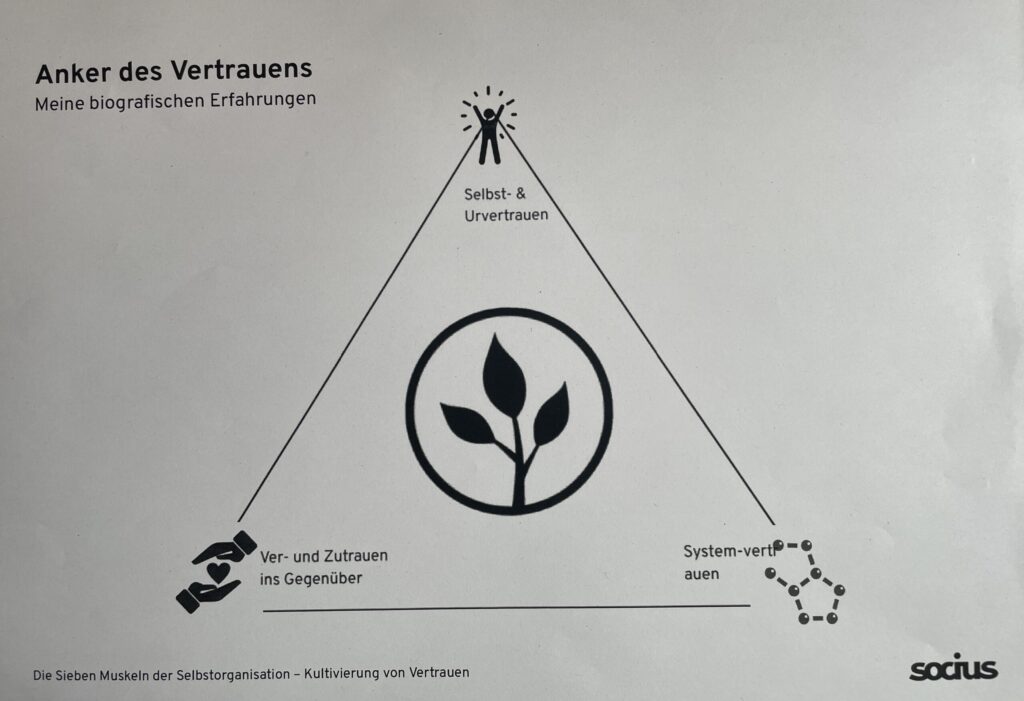 Self-confidence & basic trust - the inner basis. Banduras self-efficacy, Erikson's psychosocial development phases. The question: What sustains me, even if there is no certainty?
Trust & confidence in the other person - the dynamic space between people. Trust as a process, not as a state. And trust as a decision, not as naivety.
System trust - Trust in rules, structures and institutions. Luhmanns Complexity reduction: without this, we can hardly get up in the morning, let alone work in self-organised teams.
Brené Brown put it like this: „We need to trust to be vulnerable - and we need to be vulnerable in order to build trust." The chicken-and-egg problem of trust.
An exercise and my discomfort
There was an exercise in the lab that still keeps me busy today.
Three people with one task: think about what you will do together in the five minutes after the end of the event and commit to it. But: only one person alone decides what all three of you will actually do. The algorithm devised by the speakers decides who this person with decision-making power is.
I was the person who decided. The others had to follow the exercise.
I am not weak in making decisions. I can provide guidance, lead the way and, if in doubt, follow through on appointments. But at that moment, I found it simply absurd: I was the oldest person in the group, I was in my work home at SOCIUS, so I was already highly placed. And now I was supposed to decide what two people I almost didn't know were doing?
My decision was: „Everyone does what they want and what is good for them.". And I added what we had previously discussed as a possible appendix, so to speak. Andi commented dryly: „That's a bit of cheating."
He was not wrong. The exercise made something important really tangible for me: Power without relationship, grown trust and shared context - that doesn't feel like leadership, that feels arbitrary.
Trust is not created by assignment. It grows - with Wolfgang Looss spoken - with agreements that are honoured. With time, vulnerability and courage.
Communities of mistrust - the other form of trust
 Aladin El-Mafaalani's diagnosis of society also concerns me personally. The sociologist describes how communities have emerged in recent years that are not held together by shared values, but by shared mistrust. Those who belong do not need expertise or experience, nor a shared vision; it is enough to distrust the same institutions and experts, i.e. the same "system". Mistrust itself becomes the social glue. However, mistrust is not bad per se, as El-Mafaalani explicitly emphasises. "Functional mistrust" is necessary because it protects and scrutinises. It keeps systems in motion.
I know this from my own biography. I studied law in Göttingen in the early 90s, I'm critical of the system, feminist, left-wing. My children went to independent alternative schools because we didn't think the state school system with grades, little exercise for the children, severe restrictions on self-determination and, as a result, a lot of family stress with homework, class tests and assessment pressure was trustworthy enough. As a family, we underwent curative treatment for years. And at the same time: the children were vaccinated, went to the paediatrician regularly, and today I walk around - figuratively speaking - with the Basic Law under my arm and insist on Article 3 and other fundamental and human rights.
Is that a contradiction - or a differentiated mistrust? My criticism of the system has always been that it doesn't protect enough, neither women nor children, nor other marginalised people. It supports patriarchal and capitalist structures that exploit the weaker. I maintain that my mistrust is based on something towards orientated: Justice, participation, protection.
What El-Mafaalani describes is something else. The tipping point comes when mistrust no longer indicates anything, but only against something. When there is no longer a common horizon apart from the common enemy and expertise is rejected across the board because scientific justifications are reinterpreted as control instead of protection. When "The state is failing" becomes: "The state is basically my enemy."
Adorno has said: "There is no right life in the wrong one." This is not a call for paralysis, it is a call for vigilance. And vigilance requires the ability to distinguish between functional mistrust, which strengthens democracy, and destructive mistrust, which undermines it.
What does this mean for self-organised teams? Trust must be cultivated: actively, consciously, structurally. It is not enough to dismantle hierarchies and hope that trust will develop by itself. Self-organisation needs the triangle:
- People who trust themselves.
- Structures that create reliability.
- And the willingness to trust - even if there is no worst-case network underneath.
And then there was the Baltic Sea
 A week after the lab, I travelled to the sea again. The Baltic Sea instead of the Atlantic. But the sea is the sea. Three days and I knew who I was again. Cultivating trust perhaps begins right there: in what brings us back to ourselves. Before we can trust others, before we can trust systems, we have to recognise ourselves again. This is not an esoteric thesis. This is what Erikson, Bandura and Brené Brown meant.
And what I feel by the sea.
 Deutsch
  English (UK)