
Look when it hurts
Global Social Witnessing and living with chronic illness
Author:in: Nicola Kriesel
It was a Monday evening and I was nervous.
In front of me: the screen with the zoom tiles, which was slowly filling up with the faces of my peer group, and a script that I had written myself - because English is not my first language and I wanted to make sure that I wasn't forgetting anything important. I was about to write a so-called Global Social Witnessing Session as part of the facilitator training programme. Topic: Living with chronic illness.
A topic that I know not only from books.
What is Global Social Witnessing?
We live in a time in which we are inundated with news every day. Wars, climate catastrophes, social injustices, discrimination, poverty, exploitation, violence. At some point, we switch off - not because we are heartless, but because our nervous system is simply overfordert.
This is precisely where Global Social Witnessing (GSW) comes in. The Pocket Project led by Kosha Joubert has developed a training programme with many international experts to facilitate Global Social Witnessing Calls. I have been taking part in this training since April 2025.
The basic idea of GSW: We humans have the ability to remain mindful of what is happening in the world - without looking away, without becoming numb, without becoming unfeeling. We need to practise this ability.
GSW follows three steps:
- First the attentive perception - You pause instead of scrolling on. You really let the information sink in.
- Then the inner resonance - You feel for yourself: What does this do to me? Where does it show up in your body? Is something tightening in your chest? Is there sadness? Anger? The event turns from an abstract number into a human experience.
- And finally the reflected answer - From this pause, you can act more consciously. Not out of panic or anaesthesia, but out of clarity.
Brené Browns "Strong back - soft front - wild heart" For me, this fits in perfectly with the Global Social Witnessing approach.
1.3 billion people - and we hardly look at them
Chronic diseases are now the leading cause of death worldwide, accounting for around 75% of all deaths. Around 1.3 billion people, or one in six people on the planet, live with a significant disability that is often caused by chronic diseases.
These are not abstract numbers. They are neighbours, colleagues, friends and family members. Maybe you are one of them yourself.
And yet, this topic is largely invisible to society. This is because many chronic illnesses - autoimmune diseases, chronic pain, ME/CFS - do not show themselves from the outside. Anyone who is not in a wheelchair or does not look visibly ill is often not recognised as being ill. The world is built for healthy, productive people - with 9-to-5 working hours, long commutes, social expectations of energy and presence.
Anyone who deviates from this falls through the net. .
What I felt in that Monday session
I started the session with a breathing exercise - the so-called Cardiac Coherence, which I again saw for the first time in the Art of Hosting Training I learnt 5 years ago.
Inhale for six seconds, exhale for six seconds, six times in a row.
The idea behind it: If we breathe together in this rhythm, our heartbeats synchronise - even across four time zones and two continents, just like in "my" call.
At that moment, I realised why I had chosen this topic.
Not just because the figures are frightening. But because I know what it feels like when your body and mind don't work the way the world expects them to. When you look „normal" on the outside and are struggling on the inside. When you have to explain what can't be explained from the outside.
In our salons on "Illness in organisations", we have been dealing with this topic since October 2024, often on a very personal level, and I wanted to bring the topic to a wider audience and give it a global dimension.
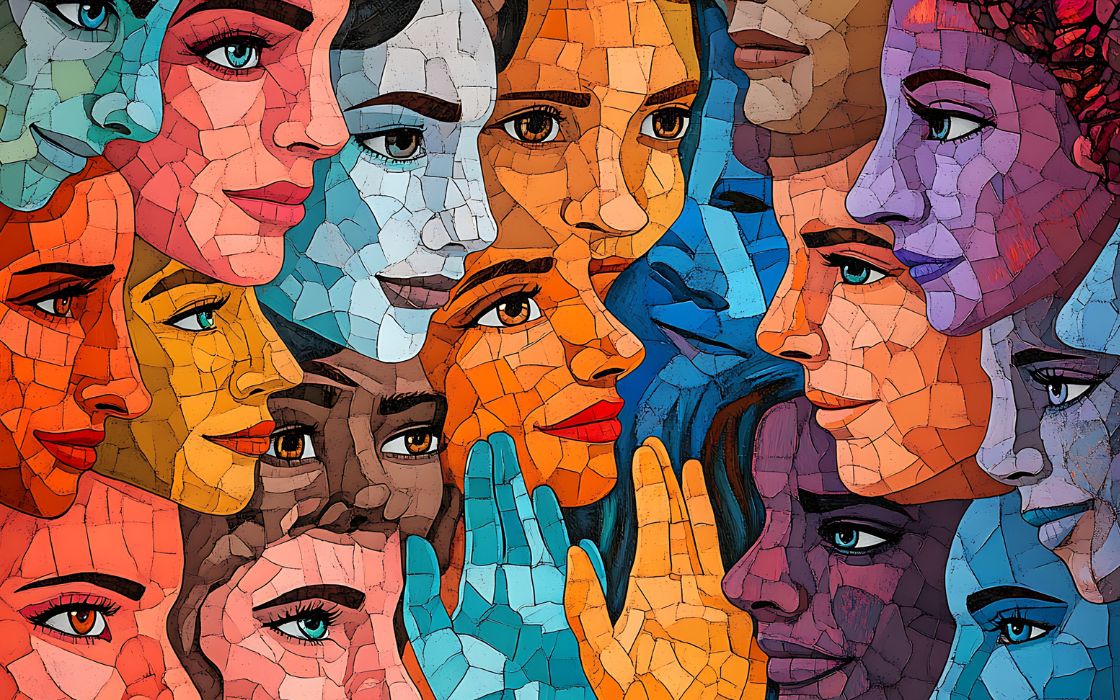
In the session, I then acted as the host and witnessed my peer group. It was a really interesting experience for me, because my colleagues were all surprised by my choice of topic. They could hardly look at the pictures I had chosen of sick people and, with what's going on in the world this week, had probably expected me to "bring" something about the US attack on the Islamic Republic of Iran. The big global world news stories are usually what make it into the Global Social Witnessing Calls. My topic was personal. And global. Not far away in Iran, Ukraine, the Brazilian rainforest. But really everywhere. Right next door. Or even in my own body.
What does that do to you? When you see such a personal issue, which is repeatedly privatised, suddenly placed in a global context?
We then explored this together.
What happens when we look collectively?
GSW does not claim that looking at the world will save it. But it does claim that looking away makes it sicker - in the literal sense. Collective traumas that are not felt and processed become ingrained. They become unconscious cultural patterns that are passed on from generation to generation.
When we as a society learn to dwell on what is difficult - on the invisible illnesses, on the silent exhaustion, on the people who fall out of the system - then something begins. Not a revolution, perhaps. But a crack in consciousness through which light can shine.
An invitation
You don't have to attend a GSW session to get started.
The next time you see a headline about health, poverty or exhaustion - don't scroll on immediately. Pause for a moment. Breathe in and out deeply and ask yourself: What does this do to me?
This is the beginning.
Because in order to heal a wound - even a collective one - it must first be seen and felt.

If you are interested in 'Working with chronic illness", please come to our "Illness in organisations salon" - always on the 13th of the month.
 Deutsch
  English (UK)